




A plain-English guide for merchants
How payment processing works
A clear walkthrough of how a card payment moves from your customer to your business bank account, including every step, the key players involved, and the industry terms every merchant should know.
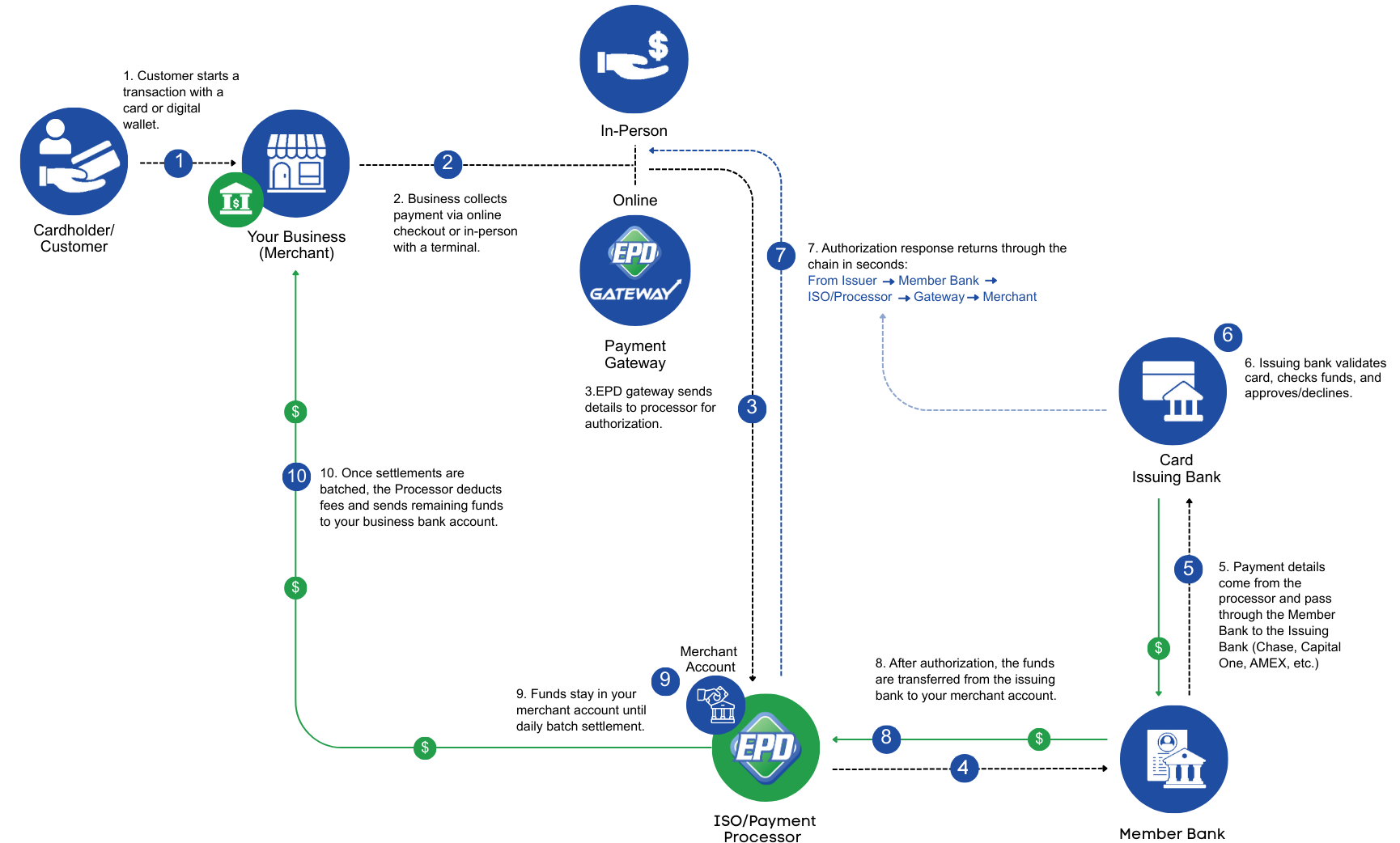
The steps of payment processing
Every card payment moves through the same sequence of steps. Here is what happens from the moment a customer decides to pay to the moment the money lands in your account.
1. Customer initiates a payment. The process begins when a customer purchases something and provides their payment details online or in person (credit card, debit card, ACH, digital wallet, and so on).
2. Merchant captures payment info. The merchant captures the customer payment details using a payment terminal (in person) or a payment gateway (online), which securely encrypts the information.
3. Payment gateway transmits data. The payment gateway forwards the encrypted payment data to the payment processor. This is the middleman that connects the merchant with financial institutions.
4 and 5. Processor routes the request to the issuing bank. The processor sends the payment details through the member bank to the issuing bank (for example Capital One, American Express, or another card issuer).
6. Issuing bank verifies and approves. The issuing bank checks whether the card is valid and whether there is enough balance or available credit, then approves or declines the request.
7. Authorization response is sent back through the chain. The issuing bank sends the approval or decline message back through the member bank, then to the processor, then to the gateway, and finally to the merchant. This happens in seconds.
8. Funds are deposited into the merchant account. After authorization, the funds are transferred from the customer issuing bank to the merchant account.
9. Settlement. Funds remain in the merchant account and are released once transactions are grouped and settled in daily batches.
10. Funds transfer to the business bank account. Funds move from the merchant account to the designated business bank account, usually on a daily or weekly schedule, depending on the processor funding terms.
Key players
When a customer makes a purchase, a network of key players works together behind the scenes to move money securely from their account to the merchant account. Each has a specific role in ensuring the transaction is authorized, settled, and funded smoothly.
Cardholder or consumer. The customer making the purchase.
Online shopping cart. A software tool on ecommerce websites that lets customers select products, view totals, and complete their purchase. It connects to the Easy Pay Direct gateway to securely process payments.
Payment gateway. A software service that captures and encrypts customer payment info (like credit card details) and securely sends it to the payment processor. Think of it as the digital cash register for online transactions.
The payment processor. The middleman tech system that routes payment data between the gateway, banks, and card networks.
Member bank. A bank that is part of the Visa and Mastercard networks and underwrites the merchant account.
Merchant account. Where the merchant receives the funds.
Card issuing bank. The customer bank, the one that issued their credit or debit card. It approves or declines the transaction and pays the money to the member bank.
Card brands (Visa and Mastercard). Not shown in the diagram, but they act as the governing association over the rules and brand protection.
Important industry terms
The payment processing industry comes with its own language. Understanding these terms makes it easier to read statements, compare providers, and talk to your processor.
Authorization. Real-time check to approve the transaction.
Settlement. Movement of actual funds after approval.
Batch. A day of approved card transactions (the batch) are finalized and the funds are transferred to the merchant bank account (settlement).
Merchant account provider. Another term for the ISO or processor.
Association. Refers to card brands like Visa and Mastercard.
Payment processing questions, answered
Common questions about how a card payment moves from your customer to your business bank account.
How long does payment processing take?

What is the difference between authorization and settlement?
What is a payment gateway and do I need one?
What is the difference between a payment processor and a merchant account?
What is a batch in payment processing?
Who are the key players in a card transaction?
A top-trusted credit card processor

100K+ Businesses
$12B+ Processed
20+ Years
500+ Integrations


Ready to accept payments
Tell us about your business. We will underwrite your account and get back to you within one business day.
Your information will not be sold or distributed.